
About the research
Progress towards gender equality in some areas sits alongside persistent gaps in others. Understanding these differences and identifying where meaningful change is still needed requires robust, comparable evidence.
Yet until recently, there has been no comprehensive, UK-wide measure capable of capturing this complexity at a local-level. The Gender Equality Index UK (GEIUK) offers a solution to this problem.
The GEIUK is the first index to systematically measure and analyse the socioeconomic outcomes of women and men across all 372 local authorities in England, Scotland, Wales and Northern Ireland. By combining data across key domains, the GEIUK provides a detailed picture of what gender equality looks like today – and where targeted action is most needed.
Why?
Why was this research important?
To date, the UK has had no comprehensive measure of gender equality. Existing indicators are fragmented, often inaccessible and rarely capture regional variation. The GEIUK was developed to provide a multi-dimensional, geographically sensitive tool that addresses this evidence gap.
By combining gender gaps, women’s outcomes, and men’s outcomes, the GEIUK delivers the most detailed picture yet of gender and geographic inequalities across all four nations. It shows not only where women are disadvantaged, but also where men and women alike are falling behind national averages.
To make this evidence accessible, the GEIUK is available via an interactive public website, opening the data to policymakers, devolved administrations, researchers, NGOs, advocates and citizens. This transparency ensures the findings can inform policy design, accountability and public debate.
Why was this research needed?
In the UK, despite considerable progress over past decades, gender inequalities persist alongside deepening regional inequalities. Evidence suggests that socioeconomic outcomes vary not only across the four nations, but also between neighbourhoods within the same cities.
To design and implement effective, tailored policies to address these inequalities, we need a better understanding of how gender and geography intersect. Existing measures often focus solely on gaps between men and women, which can mask shared disadvantage.
To address this and capture the full picture of gender equality across the UK, the GEIUK combines three complementary measures:
- Gender equality measure: the gaps between women and men in a local authority, irrespective of the direction of (dis)advantage
- Women’s outcome measure: the gaps between women locally and women nationally
- Men’s outcome measure: the gaps between men locally and men nationally.
Together, these measures offer the most comprehensive picture of gender and geographic inequality in the UK.
How?
How was the research carried out?
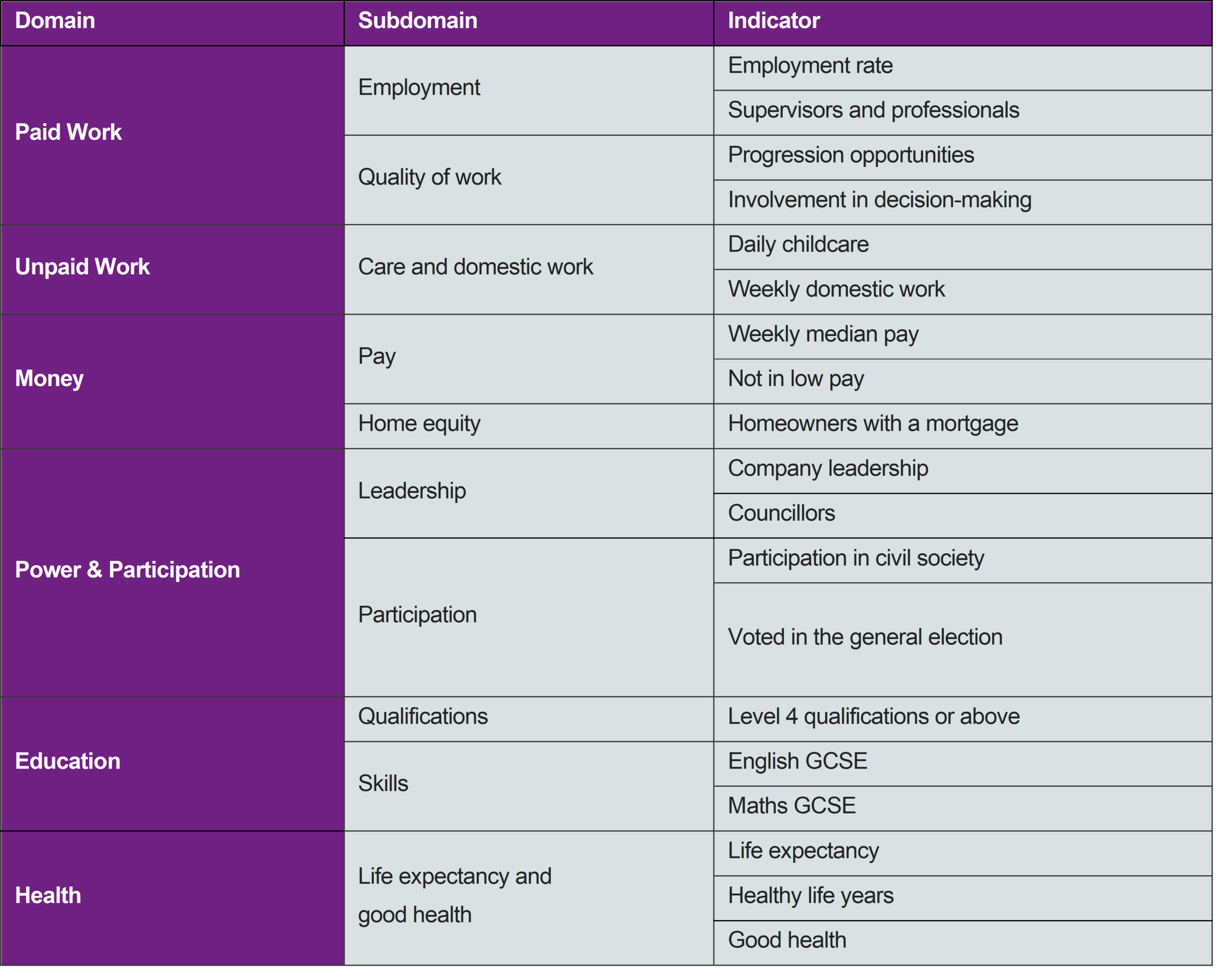
The GEIUK framework was developed through literature and policy reviews, advisory board consultations and engagement with academics and women’s organisations. This resulted in six domains being identified to capture gender equality:
- Paid Work
- Unpaid Work
- Money
- Power & Participation
- Education
- Health.
This framework then guided the sourcing and assessment of relevant indicators, designed to provide measurable, evidence-based insights into local and national outcomes. A full list of the domains, subdomains and indicators selected can be found in Figure 1.
The full GEIUK report details the difficulties in harmonising data across the UK at the local area level and puts forward recommendations for data improvement.
Figure 1: Overview of domains, subdomains and indicators constituting the GEIUK.
Larger image / Accessible version.
Within these domains, 19 indicators were selected using sex-disaggregated data from a range of high-quality national datasets, published between 2021 and 2023 for the four UK nations at the local authority level.
For a full description of the methodology, including the rationale for indicator selection, the theoretical and policy relevance of the domains, and approaches to aggregation, weighting and data quality checks, please see the full GEIUK report.
How did data held by the UK Data Service help the researchers?
A key challenge in developing the GEIUK was identifying data that could capture under-represented outcomes. This is where Understanding Society, accessed via the UK Data Service, came in.
As the UK’s largest longitudinal household survey, Understanding Society provided rich, nationally representative data that enabled measurement of Unpaid Work and Power & Participation domains.
Unpaid Work
Unpaid work is at the heart of gender inequalities with care and domestic responsibilities still disproportionately falling on women, significantly constraining their opportunities to participate equally in the labour market, politics and community life.
Using the UK Data Service Data, the GEIUK shows that in 2023, women spent an average of 12 hours weekly on domestic work compared to 7 hours for men.
Power & Participation
Power & Participation is equally critical, as equal access to political, business and civic decision-making is fundamental to achieving gender equality.
UK Data Service data shows that the gender gap in voting at the 2019 general election varies substantially across the UK: from negative 38 percentage points (a lower percentage of women voting) up to 34 percentage points (a higher percentage of women voting).
Without the data provided through the UK Data Service, these domains could not have been analysed in the same way, limiting the comprehensiveness of the GEIUK.
How did the researchers do something new with the data?
The GEIUK is the first index to comprehensively measure and analyse the socioeconomic outcomes of both women and men across all UK local authorities.
Unlike traditional measures, which focus on gaps between women and men, the GEIUK also contextualises these gaps by comparing local outcomes with national averages. This helps to reveal how gender and geographic inequalities intersect, offering insights that would otherwise remain hidden.
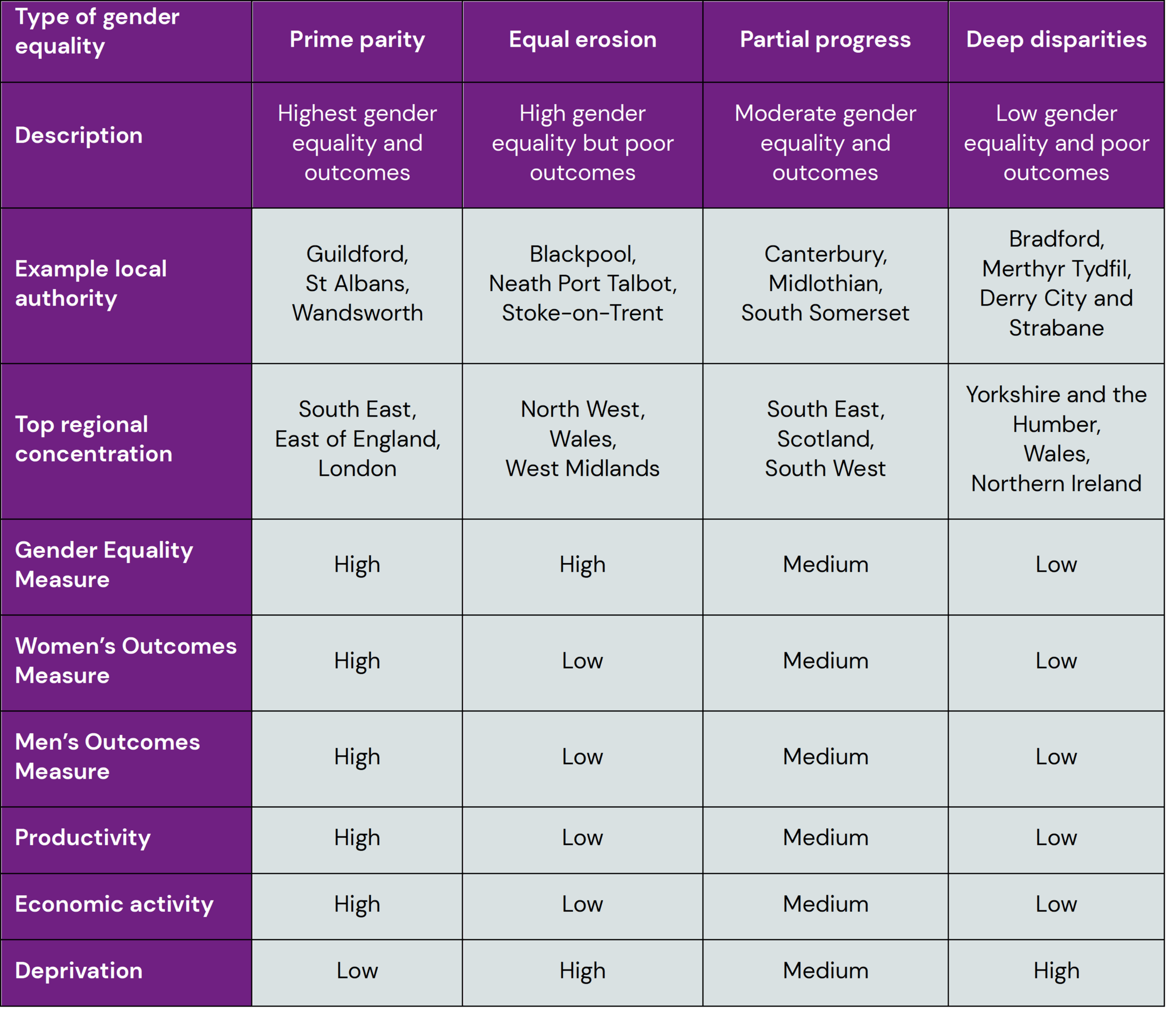
Specifically, the GEIUK reveals four distinct ‘types of gender equality’ existing across UK local authorities:
1. Prime Parity
Areas like Guildford, St Albans and Wandsworth, where high gender equality coincides with high socioeconomic outcomes for both women and men. One in seven (15%) local authorities in the UK fall into this category.
2. Equal Erosion
Found in one in five (19%) local authorities, and represented by places such as Blackpool, Neath Port Talbot and Stoke-on-Trent. These are areas where gender equality appears higher only because women and men share similarly poor outcomes.
3. Partial Progress
The most commonly identified type of gender equality across the UK, with 40% of all local authorities falling into this category. These are places characterised by moderate gender equality and average outcomes, such as Canterbury, Midlothian and South Somerset.
4. Deep Disparities
Places including Bradford, Merthyr Tydfil, Derry City and Strabane, where significant gender gaps exist alongside poor outcomes for both women and men. This type of gender (in)equality is found in a quarter (26%) of all local authorities.
The full details on each of these types of gender equality can be seen in Figure 2.
Figure 2: Description of the types of gender equality found based on average demographic and socioeconomic variables.
Larger image / Accessible version.
These illustrate the complexity of gender equality across the UK. A narrow gender gap can result from either shared prosperity or shared deprivation.
These findings emphasise the importance of adopting a dual strategy: advancing gender equality while improving overall socioeconomic conditions for both women and men through interventions tailored to the local context.
What?
What are the findings?
Results from the GEIUK analysis revealed significant disparities in outcomes for both women and men, with no UK local authority achieving full gender equality.
Julia Gillard, former Prime Minister of Australia and Chair of the King’s Global Institute for Women’s Leadership, describes:
“The findings from this index reveal that while no local authority has yet achieved gender parity, those coming closest often exhibit greater local productivity and higher outcomes for all. This suggests a profound opportunity – not just to close gender gaps, but to promote inclusive regional growth and shared prosperity.”
Key findings from the analysis fell into nine areas:
1. No local authority has achieved full gender equality
Substantial disparities exist across localities with men showing higher outcomes in Paid Work, Money and Power & Participation. Conversely, women’s outcomes are higher in Education and Health, and they continue to spend more time on Unpaid Work, including childcare and domestic work.
2. Gender equality is highest in London and the North West, but dynamics vary
A narrow gender gap is not necessarily positive – it depends on the outcomes for both women and men.
3. Lowest equality occurs where both women and men are falling behind the national average
Poor outcomes affect everyone.
4. Four distinct types of gender equality exist across the UK
Full detail on each of these types of gender equality, including a description, example local authorities and top regional concentrations can be seen in Figure 2.
5. Gender equality flourishes where both women and men do well
Progress benefits the whole population.
6. Gender equality is associated with higher productivity and economic activity
Promoting equality has clear economic benefits for all.
7. Gender inequalities are especially large in the domains of Unpaid Work and Power & Participation
These are key domains for targeted intervention.
8. Men spending more time on unpaid work is linked to greater equality
Shared domestic responsibilities matter.
9. Clear North-South socioeconomic divide
Highlighting ongoing regional disparities in outcomes.
The index shows that more gender-equal areas tend to have stronger economic activity, higher productivity, better wages and lower levels of deprivation. This suggests that gender equality should not only be pursued as a goal in itself, but as a route to more inclusive growth and regional development.
“Gender equality is a win-win: it flourishes where men and women both do well”
In the UK Data Service’s recent Data Impact blog post looking at the GEIUK, these findings are explored in more depth, with full details available in the full GEIUK report or on the dedicated key findings webpage.
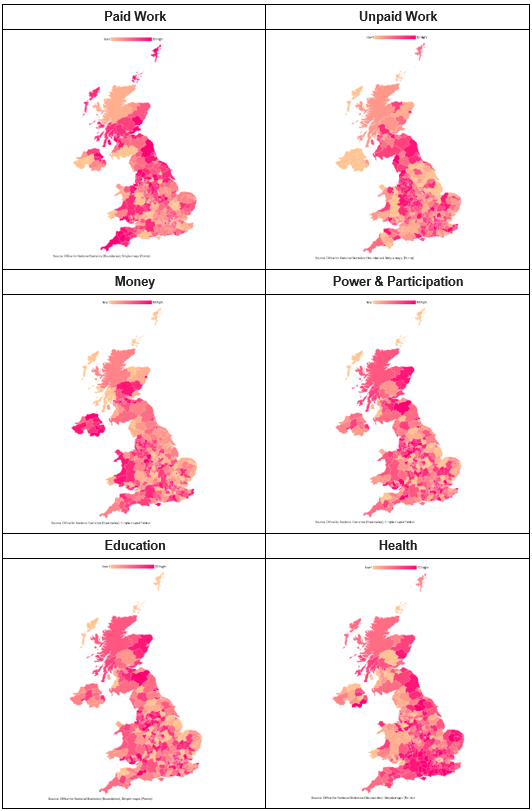
An interactive public website was also created, which allows policymakers, researchers and the public to explore the GEIUK data, identifying where inequalities are most pronounced and where progress can be made. Some examples from this can be found in Figure 3.
Figure 3: Examples of interactive maps showing an overview of domain scores of the Gender Equality Measure with a darker colour representing higher equality.
Larger image / Website to explore maps in full.
These interactive maps make it clear where gender inequalities are most entrenched, offering a powerful tool for evidence-based decision making. They show not just the scale of the challenge, but also where targeted action could deliver the greatest impact.
What are the key lessons for policy and advocacy?
Building on these insights, the GEIUK findings highlight key lessons for policy and advocacy:
1. Gender equality is a win-win – both women and men benefit
When gender equality is higher, both women and men achieve better socioeconomic outcomes, highlighting the wider benefits of gender parity.
2. Reduce gender inequalities in the domains of Unpaid Work and Power & Participation
We need to support a more equal division of domestic and care work through flexible working, parental leave, affordable childcare and targeted measures to increase women’s political representation and business opportunities.
3. Encourage men’s greater involvement in caregiving – it benefits them too
Extend flexible working rights, introduce non-transferable parental leave and challenge traditional gender norms to foster more egalitarian practices.
4. Regional development strategies will benefit from a gender perspective
Integrate gender-focused strategies into local and national economic policies to unlock untapped potential and support inclusive growth.
5. Tackle the barriers linked to part-time work
Reduce stigma, expand flexible working, and improve access to childcare and after-school provision to support women’s labour market participation.
6. Strengthen the UK gender data landscape
Improve coverage and quality of sex-disaggregated and intersectional data, including time-use, wealth and violence indicators to enhance the GEIUK and support evidence-based policymaking.
What was the impact?
Although the GEIUK launched only recently (May 2025), its influence is already beginning to take shape across policy, research, advocacy and public understanding. By providing a robust, localised evidence base, the GEIUK is sparking conversations and collaborations that are helping shape how gender equality is measured, discussed and acted upon.
1. Policy and decision-making – early adoption across local and national contexts
The GEIUK is being recognised as a valuable tool for informing policy discussions and strategic planning. Early engagement with local authorities and women’s organisations is underway, with interest in using the index to support local equality strategies and funding decisions.
At the national level, the GEIUK has already featured in written evidence for UK Parliament Select Committees, including contributions by:
- The Women’s Budget Group submission to the Public Administration and Constitutional Affairs Committee on the work of the UK Statistics Authority (June 2025).
- Professor Zara Quigg, Director of the World Health Organization Collaborating Centre for Violence Prevention, submitted evidence to the Home Affairs Committee inquiry into Violence Against Women and Girls (May 2025)
- The Global Institute for Women’s Leadership submitted evidence to the Home Affairs Committee inquiry into Violence Against Women and Girls (March 2025).
The latter submission, which draws on the GEIUK, informed the Committee’s inquiry into ending violence against women and girls in Northern Ireland.
The inquiry’s findings were subsequently acknowledged and addressed in correspondence with the Home Office between Jess Phillips MP, Minister for Safeguarding and Violence Against Women and Girls, and Tonia Antoniazzi MP, Chair of the Northern Ireland Affairs Committee.
2. NGO and advocacy engagement – strengthening evidence for gender equality campaigns
Civil society organisations are actively engaging with the findings of the GEIUK. The Women’s Budget Group has used the index to advocate for evidence-based gender policy, including through its publication Gender equality is not a zero-sum game: What the new Gender Equality Index tells us.
The research team has also presented the GEIUK to a range of advocacy groups and think tanks, including White Ribbon (August 2025), the Resolution Foundation (November, 2024) and GM4Women2028 (February 2024). Ongoing dialogue with ONS Local reflects growing interest in the index as a tool for localised gender analysis.
3. Public awareness and media engagement – reaching broader audiences
The launch of the GEIUK in May 2025 generated public interest. The event and panel discussion, Mapping Progress: Launch of the Gender Equality Index UK, chaired by The Hon Julia Gillard AC and featuring Professor Kate Pickett was sold out and sparked lively debate on how data can inform equality policy.
Media coverage has included a presentation by The Hon Julia Gillard AC on BBC Radio 4 Woman’s Hour, further extending the reach of the index to a national audience.
Most recently a webinar, The Power of Localised Data for Gender Equality (September 2025), co-hosted by King’s College London and the Women’s Budget Group, attracted 184 participants.
4. Reach and engagement – demonstrating growing demand
From its launch in May 2025 to October 2025, the Gender Equality Index UK has attracted 2,900 unique visitors (7,900 total visits), with an engagement time spent of 137 seconds, (with the average being 54 seconds). This early digital engagement highlights growing demand for accessible, data-driven insights on gender equality.
5. Research and academic use – a foundation for future studies
The GEIUK is beginning to establish itself as a foundation for new research. It has been used in funding applications and as the basis for a Masters thesis in Data Science at the University of Manchester.
While formal citations are still forthcoming, the index has already been presented at major academic events, including the NCRM MethodsCon (skills development workshop) and at the UK Data Service and Office for National Statistics Labour Force and Annual Population Surveys User Conference 2024.
What are the next steps?
The GEIUK’s detailed, geographically granular approach provides a foundation for future research and policy engagement.
Key next steps include:
- Further analysis and updates: Integrate historical and emerging datasets to track changes over time and assess policy impact
- Local service evaluation: Examine how infrastructure, childcare and housing affect gendered outcomes across local areas
- Cultural, political and attitudinal research: Explore connections between GEIUK scores, gender norms and political attitudes to inform initiatives fostering equality
- International adaptation: Apply the three-measure framework in other national or regional contexts to support benchmarking and global dialogue on ‘types of gender equality’.
The GEIUK is more than a measurement tool – it is a roadmap for policymakers, researchers and advocates.
By highlighting where inequalities are greatest and identifying pathways for progress, it supports evidence-based interventions that can foster more inclusive, resilient and thriving local economies across the UK.
Professor Heejung Chung, Director of the King’s Global Institute for Women’s leadership says:
“Our research highlights the benefits of gender equality for men. For instance, in contexts where men take on a greater share of unpaid care work, they tend to experience better socioeconomic outcomes. This report reaffirms that gender equality is not, and has never been, a zero-sum game. It offers a set of blueprints for how we can develop and support communities in which both men and women can prosper.”
Additional information
Publications
Schmid, C., Onah, C. N., Humbert, A. L., Sojo, V., & Cowper-Coles, M. (2025). Mapping progress: Findings from the Gender Equality Index UK. Global Institute for Women’s Leadership. https://www.kcl.ac.uk/giwl/assets/mapping-progress-gender-equality-index-uk-full-report.pdf
Research funding and partners
The Gender Equality Index UK was developed with generous funding from the Lloyds Banking Group.